ASME Section VIII vs IS 2825 — Comparative Analysis
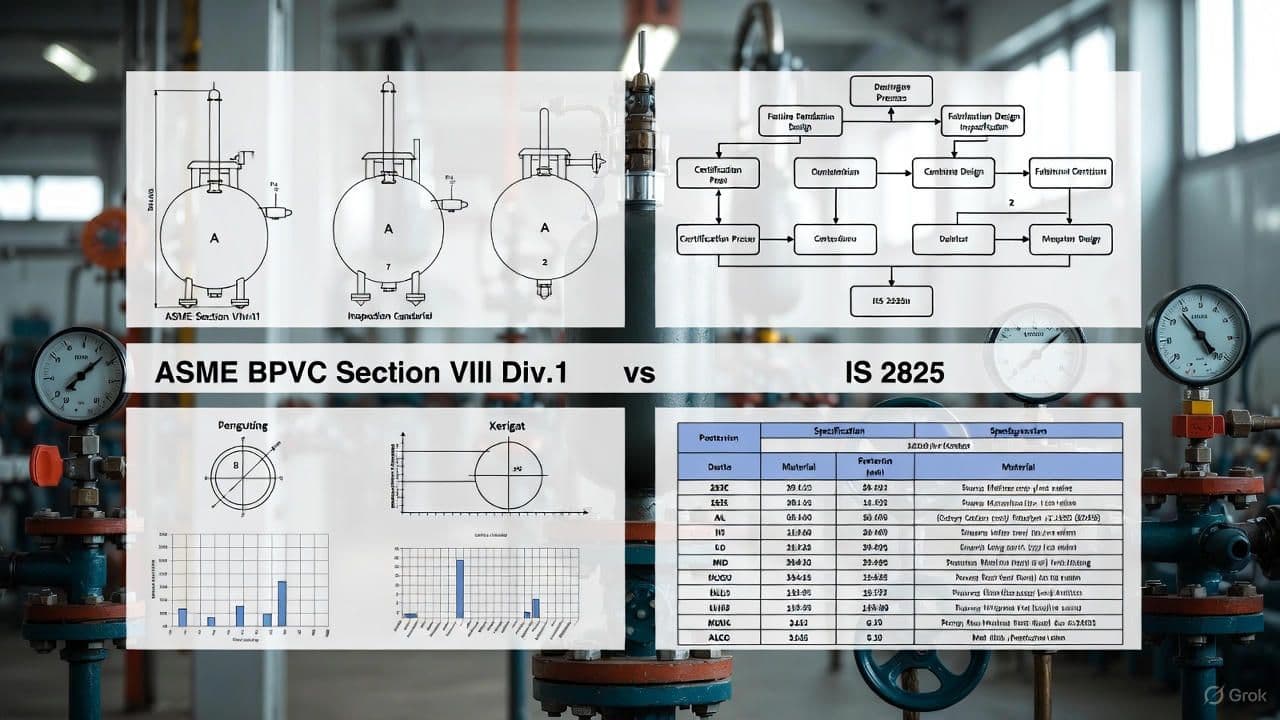
Comparative Analysis of ASME BPVC Section VIII and IS 2825 Pressure Vessel Codes
Scope: Side-by-side engineering-focused comparison covering code philosophy, material/allowable stress basis, principal design formulas, fabrication/welding & PWHT, inspection & testing, marking/certification, and practical implications for design/fabrication engineers.
1.0 Executive summary
ASME BPVC Section VIII, Div.1 and IS 2825 both provide complete design-by-rule frameworks for pressure vessels but differ in philosophy and specific technical rules. IS 2825 uses a class-based, duty-driven structure (Class 1-3) and allows allowable stresses based on yield or tensile with lower safety factors in some cases; ASME applies a material- and service-driven approach using tabulated allowable stresses (Section II) and a generally more conservative tensile-based factor for internal pressure. These differences affect thickness, weight, NDE scope, PWHT practice, and documentation paths - all of which have direct cost, manufacturability, and compliance implications for international projects.
2.0 Foundational philosophy & classification
2.1 IS 2825 - tiered, duty-driven
- Classes:
- Class 1: Highest duty - strictest design, fabrication, inspection.
- Class 2: Medium duty - moderate requirements; spot radiography requirements for key joints.
- Class 3: Light duty - plate thickness ≤ 16 mm and limits on vapor/hydrostatic pressures (e.g., working vapor ≤ 3.5 kgf/cm² or hydrostatic ≤ 17.5 kgf/cm²).
- Design drivers: Duty/class determines inspection extent and some fabrication rules.
2.2 ASME Section VIII, Div.1 - material/service-driven
- No tiered class system; uses parts and P-Numbers (e.g., UCS, UHA) and material tables in ASME II for allowable stresses.
- Special service provisions (e.g., lethal service) add rule layers.
- Design drivers: material group, temperature, service, and tabulated stress values.
Practical implication: IS 2825's class approach ties inspection & QA early to service; ASME centralizes design conservatism in its material tables and service-specific clauses.
3.0 Material requirements & allowable stress criteria
3.1 Philosophical difference - basis of allowable stress
- IS 2825: allowable stress is the lower of (certified minimum yield / factor) or (specified minimum tensile / factor). Typical safety factors: yield/1.5 and tensile/3.0 for carbon steels; other factors vary by material group (see table below).
- ASME Sec VIII Div.1: allowable stress for internal pressure is primarily derived from specified minimum ultimate tensile strength using a safety factor (commonly 3.5 for many ferrous materials) and, more practically, directly from tabulated S values in ASME Section II, Part D for materials at temperature.
3.2 Consequences
- For identical material properties and pressure, ASME can produce thicker required walls (more conservative tensile-based limit) compared to IS 2825 where yield-based provision may permit thinner sections.
- ASME's tabulated stress values (S) simplify design iterations and are temperature-dependent; IS 2825 requires more direct computation using stated material minima.
4.0 Key design formulas & comparisons
4.1 Cylindrical shell under internal pressure
ASME formula (common form):
Where:
- = required thickness (m)
- = internal design pressure (MPa)
- = internal radius (m)
- = allowable stress (MPa)
- = joint efficiency (0 < E ≤ 1)
IS 2825: similar thick-walled thin-shell equations exist but allowable stress determination and some shape factors differ. IS 2825 also uses shape factors and charts more actively for formed heads.
Worked example (step-by-step arithmetic)
Design for: , , , .
- Compute numerator: .
- Compute .
- Compute denominator: .
- Compute thickness: .
- Convert: .
- Apply corrosion allowance and rounding per code (e.g., + corrosion allowance 1.5 mm ⇒ design thickness ≈ 15.912 mm ⇒ select nearest standard plate/thickness per fabrication practice, e.g., 16 mm).
Important: arithmetic shown digit-by-digit to avoid rounding errors.
4.2 Formed heads (torispherical / elliptical)
- ASME (torispherical approximate):
where (L) is a characteristic length (often crown radius or equivalent).
- IS 2825: uses a geometry-dependent shape factor (c) taken from a chart (e.g., Fig. 3.7) so required thickness for heads is not strictly linear with crown radius; designers must consult the IS chart to get (c).
Implication: IS 2825 allows more geometry optimization via charts; ASME uses closed-form coefficients.
4.3 Openings & reinforcement
- Both codes implement area-replacement for nozzle reinforcement (ASME UG-37 and IS 2825 Fig. 6.6).
- IS 2825 explicitly allows uncompensated small openings ≤ 0.05 m diameter and provides charts to determine maximum uncompensated opening vs shell diameter - a practical advantage for small nozzles.
- ASME defines tabulated allowable reinforcement limits and dimensional checks; designers typically follow UG-37 and associated figures.
4.4 External pressure (vacuum) design
- ASME: iterative use of external pressure charts (Factors A and B), combined with material charts (e.g., NF curves) - conservative, graphically driven, accounts for elastic buckling and plastic collapse, includes safety factors (commonly 3.0 on buckling).
- IS 2825: provides direct formulae for allowable external pressure and for moment of inertia requirements for stiffening rings - more formulaic and sometimes simpler to apply for standard geometries.
4.5 Flanges & supports
- Flanges: IS 2825 classifies loose, integral, optional, and checks for two load cases: operating and bolting-up. ASME uses stress component checks (e.g., hub stresses) against flange material allowable (Sf).
- Supports: Both give detailed rules (e.g., saddle design factors K3/K4 in IS 2825; ASME has nonmandatory appendices and guidance). Use of local stiffeners, saddle contact area and thermal expansion provisions must follow the chosen code.
5.0 Fabrication, welding, and PWHT
5.1 Welding procedures & qualifications
- Both codes require WPS, WPQ and procedure/welder qualification: ASME references Section IX; IS 2825 references its Section 7 and relevant standards. Qualification tests and acceptance criteria are explicit.
5.2 PWHT (Post-Weld Heat Treatment) - specific contrasts
| Topic | IS 2825 (prescriptive) | ASME VIII-1 (material tables) |
|---|---|---|
| Holding temperature (example) | 580-620 °C (prescriptive) | Table UCS-56: depends on P-No and material; e.g., some steels ~540 °C (1,000 °F) |
| Furnace entry rule | Furnace must be ≤ 300 °C when vessel moved inside | Not prescriptive in same wording; uses material-based guidance and time-at-temperature rules |
| Heating rate (example) | ≤ 220 °C/hour above 300 °C for thickness ≤ 25 mm (prescriptive) | ASME provides time-at-temperature guidance; lower temp/longer time allowed per table |
Practical impact: IS 2825's prescriptive cycle can require different furnace controls and may lengthen or complicate scheduling relative to ASME's material-based, tabulated approach.
6.0 Inspection, examination & testing
6.1 Inspection stages & NDE
- IS 2825: inspection scope is class dependent (Table 1.1). E.g., Class 2 mandates spot radiography on butt joints of categories A & B; Class 1 has more extensive radiography/UT.
- ASME: NDE extent depends on joint category, thickness, material, and joint efficiency; ASME UG and Appendix dictate radiography, ultrasonic, magnetic particle, dye penetrant, etc. Generally, ASME is less prescriptive by "class" and more by construction/efficiency criteria.
6.2 Hydrostatic & destructive-test provisions
- Hydrostatic test is mandatory in both. ASME includes specific clauses (UG-99 and UCD-115) that require at least 2× MAWP for vessels designed on destructive test data. IS 2825 has its hydrostatic test rules tied to class and service.
6.3 Records & traceability during inspection
- IS 2825 emphasizes class-based inspector involvement and “Certificate of Manufacture and Test”. ASME reliance on Manufacturer's Data Report (e.g., Form U-2A) and stamping is the standard route.
7.0 Marking, certification & documentation
| Item | IS 2825 | ASME VIII-1 |
|---|---|---|
| Marking | Stamp or permanent nameplate; nameplate mandatory for plates < 7 mm | UG-115 to UG-120 dictate required stamping/nameplate content (ASME code stamp, manufacturer, MAWP, serial no., year) |
| Certificate | "Certificate of Manufacture and Test" mandatory | Manufacturer's Data Report (Form U-2A) and ASME U-stamp for certified shops |
| Traceability | Emphasized per class and test reports | Emphasized via heat-no., mill certificates, WPS records, and U-stamp documentation |
Note: For cross-jurisdiction projects, both sets of documents should be prepared and cross-referenced to satisfy client, local authority, and insurer requirements.
8.0 Practical rules of thumb & typical ranges
- Allowable stress difference: Expect ASME to yield larger required thickness (often ~5-20% higher) for many carbon steels versus an IS 2825 design that uses yield-based limits; magnitude depends on material tensile vs yield ratio and design pressure.
- Small nozzle rule: If many small nozzles ≤ 50 mm exist, IS 2825’s uncompensated-opening provisions may reduce reinforcement material over ASME approaches.
- PWHT planning: If vessel requires PWHT per IS 2825 (prescriptive), budget longer furnace cycles and ensure furnace entry temp control (≤ 300 °C) and slow controlled heating above 300 °C.
- NDE cost: Class-driven NDE in IS 2825 can increase radiography costs if high class is specified; ASME may achieve equivalent assurance via UT + accepted joint efficiencies.
- Support design: For horizontal vessels > 2.5 m diameter, check IS 2825 saddle formulas (K factors) vs ASME recommendations - saddle bending and local shell stresses often control skirt thickness.
9.0 Worked example - comparative thickness estimate (illustrative)
Design conditions:
- Internal pressure
- Internal radius
- Material: Carbon steel with (tabulated), IS allowable (yield/tensile basis) assumed 160 MPa for demonstration (depends on selected safety factor).
Using ASME formula (as earlier) with and :
- (raw, before CA & weld reinforcement)
Using IS formula with :
- Denominator: MPa
- Numerator: MPa·m
Interpretation: For these assumed S values, IS design thickness ≈ 12.6 mm vs ASME ≈ 14.4 mm - about 14% thinner before corrosion allowance and fabrication rounding. Actual difference depends on material S values used and joint efficiency.
10.0 Figure suggestions (for reports / presentations)
- Figure 1: Flow chart contrasting decision path: IS 2825 (Class → Design rules → NDE scope) vs ASME (Material/P-No → S-tables → Service clauses).
- Figure 2: Side-by-side graph of allowable stress vs temperature for a representative carbon steel from ASME Section II vs computed IS allowable stress (yield/tensile basis).
- Figure 3: Chart showing nozzle reinforcement “uncompensated opening” limit vs shell diameter per IS 2825 and ASME UG-37 equivalent limits.
- Figure 4: PWHT cycle comparison timelines (IS prescriptive cycle vs ASME table-based time/temperature profiles).
11.0 Code selection - decision matrix (practical guide)
| Project factor | Prefer IS 2825 | Prefer ASME VIII-1 |
|---|---|---|
| Primary market: India / local regulatory requirement | ✅ | ❌ |
| Need for class-based QA & inspector involvement | ✅ | ⚠️ (ASME workable but different) |
| Need for international acceptance/owner spec outside India | ⚠️ | ✅ (ASME U-stamp globally accepted) |
| Many small nozzles where uncompensated openings save cost | ✅ | ⚠️ |
| Preference for tabulated S values & global material library | ⚠️ | ✅ |
| Conservative tensile-based allowable stress (higher safety) needed | ⚠️ | ✅ |
(✅ = strong fit, ⚠️ = conditional, ❌ = less appropriate)
12.0 Practical recommendations for design & fabrication engineers
- Define project code early. Choose code at FEED stage to lock material choices, NDE schedule, and procurement documents.
- Cross-check material S values. If switching between IS and ASME, compute S_IS and S_ASME for candidate materials and quantify mass/price differences.
- Plan NDE & inspector access. IS 2825 Class requirements may require owner/third-party inspector presence and additional radiography. Include in procurement schedule.
- PWHT capability check. Confirm local furnaces can meet IS 2825 prescriptive heating-rate and entry-temperature rules if IS code is used.
- Document mapping for export. For vessels to be used in multiple jurisdictions, prepare both code traceability documents (Manufacturer's Data Report + Certificate of Manufacture & Test) and show equivalencies for inspections/weld qualifications.
- Perform a baseline comparative estimate (material weight, labor, NDE cost, PWHT cycle time) to quantify cost difference before finalizing the code.
13.0 Conclusion - synthesis of major technical differences
- Philosophy: IS 2825 uses duty classes; ASME uses material/service & tabulated S values.
- Allowable stress: IS may permit yield-based allowances (thinner shells in some cases); ASME generally applies a tensile-based conservative view via its S tables.
- Design rules: Formulas are similar in spirit, but head thickness charts (IS) vs coefficients (ASME) and external pressure methods differ.
- Fabrication & PWHT: IS is more prescriptive in PWHT cycles; ASME uses material-based tables.
- Inspection & NDE: IS ties NDE scope to class; ASME ties to joint type, efficiency, thickness, and material.
- Documentation: Different mandatory certificate formats and marking practices exist; plan for both for cross-border projects.
Appendix A - Quick comparison table
| Topic | IS 2825 | ASME VIII-1 |
|---|---|---|
| Classification | Class 1,2,3 (duty-based) | No class; material & service driven |
| Allowable stress basis | Yield/tensile with varying safety factors | Ultimate tensile/tables (ASME II) - conservative |
| Head design | Shape factor charts (geometry dependent) | Formulaic coefficients (e.g., torispherical 0.885 factor) |
| Small openings | Uncompensated openings ≤ 0.05 m allowed (chart-based) | Area replacement rules; more conservative limits |
| External pressure | Direct formulae for allowable external pressure | Chart-based method with Factors A & B and NF curves |
| PWHT | Prescriptive cycles (temperatures, heating rates) | Table-based per P-No and thickness |
| NDE scope | Class dependent (Table 1.1) | Joint/material/thickness dependent |
| Certification | Certificate of Manufacture & Test | Manufacturer's Data Report; U-stamp |
References & standards (for procurement / engineering office)
- ASME Boiler & Pressure Vessel Code, Section VIII, Division 1; ASME Section II (Materials); ASME Section IX (Welding).
- IS 2825:1987 (Pressure vessels - code of practice) and subsequent amendments/revisions.
- Local regulations & owner specifications - always confirm applicable statutory requirements and owner code addenda.
Final notes
- This document is an engineering-focused synthesis and does not replace the word-for-word reading of the respective code books. Always consult the latest published code editions, addenda, and local statutory requirements before final design/fabrication.