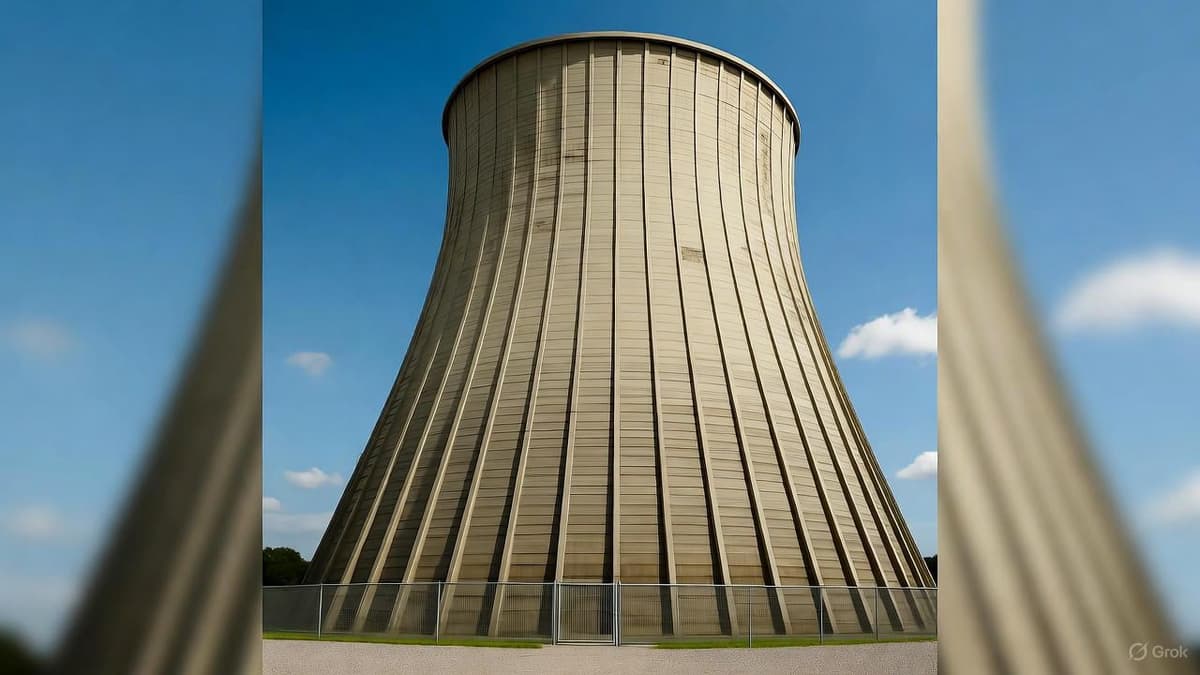
Cooling Tower Fan Power Calculation – The Definitive Guide

Cooling Tower Fan Power Calculation - The Definitive Guide
Cooling tower fans represent the largest single electrical load in many refineries, petrochemical plants, power stations and data centres - often 25-40 % of site auxiliary power. A 1 % efficiency improvement on a 50,000 m³/h tower can save $80k-$250k per year in electricity, and directly impacts Scope 2 carbon emissions. Yet most plants still size and operate fans using decades-old rules of thumb that over-estimate power by 15-35 %.
This is the exact method used by Evapco, SPX, Baltimore Aircoil, and leading global EPCs - complete equations, fan laws, industry-standard charts, real benchmarks, VFD optimisation tricks, and ready-to-use calculators.
1. The Three Types of Cooling Tower Fans in Use Today
| Type | % of Global Installed Base | Typical Specific Fan Power | Blade Material | Efficiency |
|---|---|---|---|---|
| Axial forced-draft / induced | 78 % | 0.025 - 0.045 kW/(m³/h) | FRP / Aluminium | 78-88 % |
| Centrifugal (forced-draft) | 12 % | 0.055 - 0.085 kW/(m³/h) | Galvanised steel | 65-75 % |
| Large-diameter low-speed axial | 10 % (fastest growing) | 0.015 - 0.025 kW/(m³/h) | Carbon-fibre / FRP | 90-94 % |
2. The Fundamental Fan Power Equation (Never Guess Again)
Where:
- = air flow rate (m³/h)
- = total system pressure drop (Pa or mmWG)
- for Pa, for mmWG
- (modern large-diameter ≈ 0.92-0.94)
- (IE4/IE5 premium efficiency motors)
- (direct drive) or 0.95-0.98 (gearbox/V-belt)
3. Accurate Air Flow Calculation (Modern Standard)
Forget the old “0.1-0.15 m³/s per MW” rule.
Modern CTI / Eurovent style formula:
Typical values at 27 °C WB, 50 % RH:
Modern rule of thumb:
Example: 250 MW rejected heat → ≈ 75-80 million m³/h air flow.
4. Total System Pressure Drop (The Hidden Killer)
| Component | Typical (Pa) | % of Total |
|---|---|---|
| Drift eliminators | 80-150 | 30-40 % |
| Fill pack (film or splash) | 100-250 | 40-50 % |
| Water distribution system | 30-80 | 10-15 % |
| Inlet louvers / supports | 20-50 | 5-10 % |
| Total | 250-550 Pa |
Large-diameter low-speed fans often operate at only 150-250 Pa, cutting power by 40-50 % compared to higher-pressure systems.
5. Industry-Standard Specific Fan Power Chart (Modern Benchmarks)
| Cooling Duty (MW) | Tower Type | Specific Fan Power (kW/MW) | kW per m³/h air |
|---|---|---|---|
| < 50 MW | Multi-cell induced-draft axial | 22 - 32 | 0.038 - 0.045 |
| 50 - 200 MW | Standard axial FRP blades | 18 - 26 | 0.028 - 0.036 |
| > 200 MW | Large-diameter direct-drive axial | 12 - 18 | 0.016 - 0.024 |
| Data centres | Hybrid adiabatic + large fans | 9 - 14 | 0.012 - 0.018 |
Global benchmark: Best-in-class plants achieve ≤ 16 kW/MW rejected heat.
6. Fan Laws - Your Most Powerful Tool
Where:
- = initial and final fan speeds (rpm)
- = air flow, = pressure rise, = power
VFD savings example:
Reducing fan speed from 100 % → 80 %:
- i.e. ≈ 49 % power saving
Real plants routinely save 35-55 % annual energy with VFDs plus automatic wet-bulb control.
7. Real Industry Examples
Case A - 2,100 MW Combined-Cycle Power Plant (Middle East)
- 24 cells, 85,000 m³/h each
- Old: gearbox axial fans → 28.5 kW/MW
- Retrofit: direct-drive 11 m carbon-fibre fans
- New: 14.2 kW/MW
- Saving: ≈ 31 GWh/year → ≈ $4.1M/year + ~18,000 t CO₂ reduction
Case B - Gulf Coast Refinery (600 MW Heat Rejection)
- 18 cells, upgraded to large-diameter low-speed axial fans + VFD
- Fan power reduced from 13.8 MW → 8.1 MW total
- Annual saving ≈ 42 GWh → ≈ $5.2M at $0.12/kWh
Case C - Hyperscale Data Centre (Tropical Climate)
- 120 MW cooling
- Hybrid wet-dry towers with 14 m direct-drive fans
- Achieved 9.8 kW/MW → PUE contribution < 0.012
- Beats air-cooled chillers by ~60 % in energy use
8. Ready-to-Use Excel / Google Sheets Master Formula
Inputs (cells B1-B7):
| Cell | Parameter | Example |
|---|---|---|
| B1 | Cooling duty (MW) | 350 |
| B2 | Design wet bulb (°C) | 28 |
| B3 | Total system (Pa) | 220 |
| B4 | Fan efficiency (%) | 92 |
| B5 | Motor efficiency (%) | 96 |
| B6 | Drive efficiency (%) | 100 (direct) |
| B7 | Operating hours/year | 8,500 |
One-cell result (paste in B10):
=LET(
    Q_m3h, B1*305000,
    P_kW, (Q_m3h * B3 * 0.001) / (B4/100 * B5/100 * B6/100),
    Annual_kWh, P_kW * B7,
    Annual_cost, Annual_kWh * 0.10,
    {P_kW, Annual_kWh/1E6, Annual_cost/1E6}
)
Returns an array:
- Instantaneous fan power (kW)
- Annual energy (GWh/year)
- Annual cost (million $)
9. Quick Thumb Rules (Memorise These)
| Situation | Thumb Rule |
|---|---|
| Standard axial fan tower | 25-30 kW per MW cooling |
| Large-diameter direct-drive axial | 12-18 kW per MW |
| Average speed 80 % on VFD | 45-55 % power reduction |
| Gearbox → direct drive | 4-8 % total power saving |
| Extra 100 Pa pressure drop | +12-18 % fan power |
| Carbon-fibre vs FRP blades | +4-6 % fan efficiency |
10. The Fan Selection Checklist
- Specify direct-drive permanent-magnet motors (IE4/IE5)
- For > 200 MW duty, target ≥ 11 m diameter fans
- Aim for ≤ 200 Pa total system pressure drop
- Always include VFDs with wet-bulb tracking
- Target ≤ 18 kW/MW total fan power on new builds
- Retrofit payback < 2.5 years at $0.10/kWh is common
Final Word
Cooling tower fan power is no longer a “fixed cost”. With large-diameter direct-drive fans and intelligent VFD control, best-in-class plants have cut fan energy by 50-65 % versus older designs - while improving thermal performance.
Master this calculation → slash your largest auxiliary load, hit decarbonisation targets, and unlock millions in recurring savings.